Showing posts with label Energy. Show all posts

Wednesday, April 6, 2011

Fake Plastic Trees? Maybe, but at least they're full of solar leaves!


April 6th, 2011. Nature always provides inspiration in many ways to man and the manner in which a leaf uses the sun for photosynthesis has been mimicked by Dr. Daniel Nocera of MIT. Many people have tried to do this and there are other research projects which are ongoing, but this one has succeeded. This artificial solar leaf can actually provide enough low cost energy to power a home for one day.
Earlier projects used very expensive and rare metals so were not viable for commercial use. This new solar leaf, which is actually like a small playing card, made of silicon and electronics, uses nickel and cobalt catalysts to hydrogen and oxygen ten times more than a natural leaf.
It is simple to use and merely has to be put in a gallon of water in the sunlight. The resulting energy is stored in a fuel cell which can be near the house or on top of it. The prototype was able to work continuously for 45 hours.
The ramifications for this are enormous. Electricity is in short supply all over the world and there are many places which don’t have electricity at all. Whether it is villages in rural areas in Africa or Asia or other off grid places, or even on the battlefield, or during natural disasters, this solar leaf can provide energy without power lines all over the place. For the environmentally friendly, this is another boost to reduce dependence on fossil fuels and reduce power costs.

Thursday, March 10, 2011

Solar Roooads take me hoooome....


March, 10th 2011. Sorry for the little late post guys but as you know I have gone back home for 3/4 days and guess what? I got the flu/some kind of sickness including fever as arrived, so I have not been able to write much. But here it is, the new daily post!

Winter storms recently left USA and Europe paralyzed by an overabundance of snow and ice. But what if road crews weren't as crucial for clearing streets and highways as it happened? What if the roads could clear themselves?

That's the idea behind two different solar-powered road systems currently in development. The systems would store the power of the sun to help clear streets and possibly provide an alternative source of electricity.

"We have more than 3 million miles of highways exposed to sunlight in USA, so if we can harness this energy, it's free," Rajib Mallick, Associate Professor of civil and environmental engineering at Worcester Polytechnic Institute, told CNN.

Mallick's idea is to embed pavement with fluid-filled pipes. The fluid, which would be resistant to freezing, would be heated by the sun and stored in an insulated chamber. When ice and snow hit the roads, the heated fluid could be released to melt the snow. The heat from the fluid could also be used to provide electricity to nearby buildings.

The project's cost is estimated at $12,500 for every 50 meters of pipe, plus annual maintenance costs of $1,000. But Mallick tells CNN the system could pay for itself in six months while also providing enough electricity to heat 55 homes for one month a year.

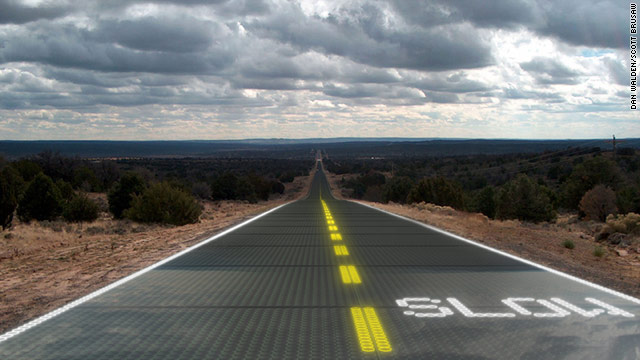
A similar idea is in development in Idaho by engineer Scott Brusaw, founder of Solar Roadways. His system would replace traditional asphalt with sturdy solar panels. The Federal Highway Administration helped fund development of his prototype.

According to Brusaw's website, "The Solar Roadway is a series of structurally engineered solar panels that are driven upon." The solar panels would power LED lights in the road lines, help melt ice and snow, and provide electricity for charging electric cars and for nearby buildings. "This renewable energy," says the Solar Roadways site, "replaces the need for the current fossil fuels used for the generation of electricity. This, in turn, cuts greenhouse gases literally in half."

Each 12 by12 foot Solar Roadway panel would cost $6,900, according to a 2009 report from PhysOrg.com. But each panel would also generate 7.6 kilowatt-hours of energy per day.

While solar-powered roads would cut state budgets for plowing, sanding and salting, finding the money to pay for them could be a challenge. "There aren't a lot of revenue sources to pay for this," Robert E. Lang, Director of University of Nevada Las Vegas' Brookings Mountain West think tank, told CNN.

But Brusaw said opposition to solar roads is more based on fear than cost. "Change. It scares people, I think."


Read the article
Read the CNN interview

Friday, February 25, 2011

New MacBookPro from Apple with a good eye on the Environment


Cupertino, CA. February 25th, 2011. February is always the month of news from Apple! After spending like crazy and getting the newest gadget for Christmas, here comes after 2 months a newer and better version of what you got so impatiently!

Voila’: the new MacBook Pro are out. They are faster, better, and more environmentally friendly. I am not getting into all the new specs of these new versions (Thunderbolt, Graphic etc.) but I am actually admiring the section that Apple has deliberately put online regarding the environment and how much CO2 is produced by each model.

First of all, congratulations for the EPA (Environmental Protection Agency) Energy Star qualification for the MacBook Pro low power consumption obtained. That is already a very good start. Secondly, lets enter more in detail about the energy savings of these new products:

(from the Apple Website)

ENERGY EFFICIENCY:

·      Efficient power supply.

MacBook Pro includes a highly efficient power supply that reduces the amount of power wasted when bringing electricity from the wall to your computer. Lower power consumption reduces energy bills and lessens the environmental impact of greenhouse gas emissions from power plants.

·      Advanced power management.

Unlike a lot of Windows-based PC systems, MacBook Pro uses energy-efficient hardware components that work hand in hand with the operating system to conserve power. Mac OS X activates sleep mode on already energy-efficient LED-backlit displays. And it balances tasks across both central processors and graphics processors. Mac OS X never misses a power-saving opportunity, no matter how small. It even regulates the processor between keystrokes, reducing power between the letters you type. That’s just one of many ways Apple manages small amounts of power that add up to big savings.

ENERGY STAR QUALIFICATION.

MacBook Pro meets the stringent low power requirements set by the EPA in their ENERGY STAR 5.2 qualification. ENERGY STAR 5.2 sets significantly higher efficiency limits for power supplies and aggressive limits for the computer’s typical annual power consumption.

ELIMINATING TOXIC SUBSTANCES:

The greatest environmental challenge facing the computer industry today is the presence of arsenic, brominated flame retardants (BFRs), mercury, phthalates, and polyvinyl chloride (PVC) in products. Apple engineers have worked hard to eliminate BFRs and PVC from MacBook Pro circuit boards, internal and external cables, connectors, insulators, adhesives, and more.1 And they’ve eliminated many other toxins that are a common part of notebook computer manufacturing — choosing, for example, mercury-free backlighting and arsenic-free glass for the MacBook Pro display.

REDUCED PACKAGING:

Every MacBook Pro comes in a smaller package than it used to — including our most popular model, the 13-inch, which ships in packaging that’s 41 percent smaller than the original. And smaller boxes are much better for the planet. Because smaller boxes mean we can fit more boxes on each shipping pallet. Which means more products will fit on each boat and plane. Which means fewer boats and planes are used, resulting in fewer CO2 emissions. It’s one seemingly minor change. But it has a major positive impact on our environment.

RECYCLABLE:

Recyclable materials.
Apple has minimized the waste when MacBook Pro reaches end of life through its ultraefficient design and the use of aluminum, which recyclers can reuse for other products.
Free recycling for your old computer.
If you live in the U.S., Apple offers a free recycling program for old computers and displays with the purchase of any new Mac.

Here are some information about the Apple Environmental plan: http://www.apple.com/environment/ 

EPEAT GOLD:

The Electronic Product Environmental Assessment Tool, or EPEAT, evaluates the environmental impact of a product based on how recyclable it is, how much energy it uses, and how it’s designed and manufactured. Through its innovative and environmentally friendly design, MacBook Pro has earned the highest rating of EPEAT Gold.

APPLE AND THE ENVIRONMENT:

Apple’s life cycle analysis accounts for all emissions associated with our products. That includes raw material extraction, manufacturing, packaging, transportation, a three- or four-year period of use,3 and recycling. In the course of this analysis, we determined that more than 95 percent of Apple’s total greenhouse gas emissions come from the products we make.

If you want to see how much CO2 is produced by your (future) brand new MacBook Pro, here are the pdf with the Environmental specs.

13” MacBook Pro: Environmental Specs
15” MacBook Pro: Environmental Specs
17” MacBook Pro: Environmental Specs

Obviously the smaller the better. Congratulations anyway to Apple for taking care of the Environment and always be transparent on the energy and environmental issues of its products. 

A solar Bicycle path that generates Solar Energy in the Netherlands


Amsterdam, February 21st, 2010. The Dutch government is launching next to Amsterdam the project SolaRoad, a bicycle lane that can generate energy from the sun. At the moment it is been tested but they’re hoping that it will be activated within the next year.

The solar-lane will be powered by a system of concrete blocks covered by a 1 cm width layer of silicon solar cells and by a layer of toughed glass. The SolaRoad will produce around 50 kWh per meter squared every year. The electricity generated will be then used for traffic lights, road illumination or houses nearby.

The first bicycle lane will be created in Krommenie, next to Amsterdam. The project has been developed by TNO, a research institute alongside the Province of North Holland, the Ooms Avenhorn Group and Imtecha; if successful it will be produced in many other cities.

For more information, www.tno.nl